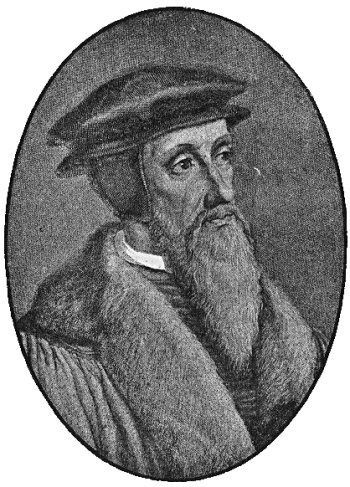
Showing posts with label Calvinism. Show all posts

Thursday, January 05, 2012

On Chastity


I'm working my way, with others, through Calvin's Institutes, and have just come across an interesting sentence in the preamble, in which Calvin addresses the French king, Francis. He outlines a number of objections to the work of the Reformation often raised by Roman Catholics. In a section refuting the claim that the Reformers are violating the faith delivered by the Church Fathers (that is, the early Christian leaders such as Augustine), Calvin points out that one of the Fathers denied the need for a celibate priesthood.

"It was a father who denied that marriage should be forbidden to the ministers of the church, and declared that cohabitation with one's wife could be chastity." (Prefatory Address Section 4. p22 in the Battles translation).


Obviously, Calvin's point was that opposition to married clergy was not universal in the early Church, indeed, that at least one authority (Pathnutius the Confessor) spoke out strongly against clerical celibacy. Except in Roman Catholic circles, that is a dead argument nowadays. We no longer have to argue in favor of married pastors.

A more interesting point concerns Calvin's use of the word "chastity." He uses it to describe the cohabitation of a husband and wife. In this, he seems to support those who interpreted the, now defunct, line in the constitution of the PC(USA) that used to hold church officers to the standard of "chastity in singleness or faithfulness in marriage between a man and a woman," to mean that sexual behavior outside marriage could be regarded as, in some sense, "chaste." I don't think that this argument holds at all. Calvin appears to be referring to the purity of a relationship; he would hardly have countenanced modern libertarianism as chastity. It's interesting to see, though, how things have changed, and how language intended to promote moral purity can be twisted to include licentiousness.

The Catholics accused Calvin of moving the boundaries of belief. His reply, that the Medieval Church had moved the boundaries, and that he was simply reinstating them, is equally valid for us. When Evangelicals within the denomination are accused of moving away from traditional Presbyterianism, one has to ask whether boundaries of belief are being moved or reinstated.

Monday, June 07, 2010

Full-Orbed Calvinism


I've been spending time reading some of the foundational sources of Calvinism (that, and bedding in a new laptop, which is why I've been quiet). The more I think about it, and as I read Hodges, Warfield and, of course, Calvin, the more I see that a mature faith must be prepared to accept opposites. At the very least, we must be able to acknowledge what appear to be logical opposites.

Part of me (probably the part that studied philosophy) wants everything to fit within a coherent system. I've always been careful to defend the Christian faith, certainly in its Reformed manifestation, as being logically consistent. Everything is internally connected. It's not folk religion with a multitude of disconnected, mutually exclusive superstitions. From the doctrine of Creation to the Fall to Salvation in Christ to the Consummation of all things, orthodox Christianity is fundamentally reasonable, in fact it's that very reasonableness that has appealed to so many people throughout the ages.


And yet: Calvin stresses God's sovereign choice as well as human responsibility. And that's not the only example of opposite beliefs. What about the doctrine of election, which stresses God's activity, and the covenant of grace, which stresses ours? Or what about the conflict between an idea like total depravity, which lies at the heart of the Calvinist sytem (certainly of the old acrostic T.U.L.I.P), and the elevation of humanity that demands so much of those who would be disciples of Christ? A peculiarly Reformed contrast can be seen in the twin ideals of separation from the world, and influence upon culture. Are we to escape from the world in order to avoid contamination, or are we to engage the world and claim the arts for Christ? Both emphases have had their place in our history. Finally, as Henry Meeter pointed out, are we to be understood as intellectuals or as mystics? There are elements of both in Calvinist churches. Which is it to be?


Instead of an 'either/or' answer, I think we need to answer, with Kierkegaard, 'both/and.' However, this not a postmodern fudge. Far from it. It is a simple acknowledgement that the mind of God is so much greater than ours.


It is possible for us to assert both divine sovereignty in terms of salvation, and human responsibility. God chooses us, but we also choose Him. The question of which one is prior need not worry us unduly. We do not need to make our theological system logically coherent, though we should certainly try. There are times when we simply have to say, "Well, here You are, Lord. Your Word teaches both, and I am unable to reconcile them, but I know that You can, so that's good enough for me."


In the end, it's our doctrine of revelation that enables us to hold competing beliefs in tension. At this time in history, God has chosen to reveal so much, and no more. But, if we trust Him, and take His revelation seriously, then we shall not pretend to know as much as God does. What we cannot afford to do, is to choose to emphasize one aspect of the faith at the expense of another. If we are to be mature disciples, or, as Calvin would say "full-orbed," then we must learn all that we can learn, we must use our minds to the best of our ability, but then we must accept that we are still fallen creatures and that we cannot understand everything. This is the point of faith - that we let God be who He claims to be. That is always enough.
Calvin and Hobbes...